
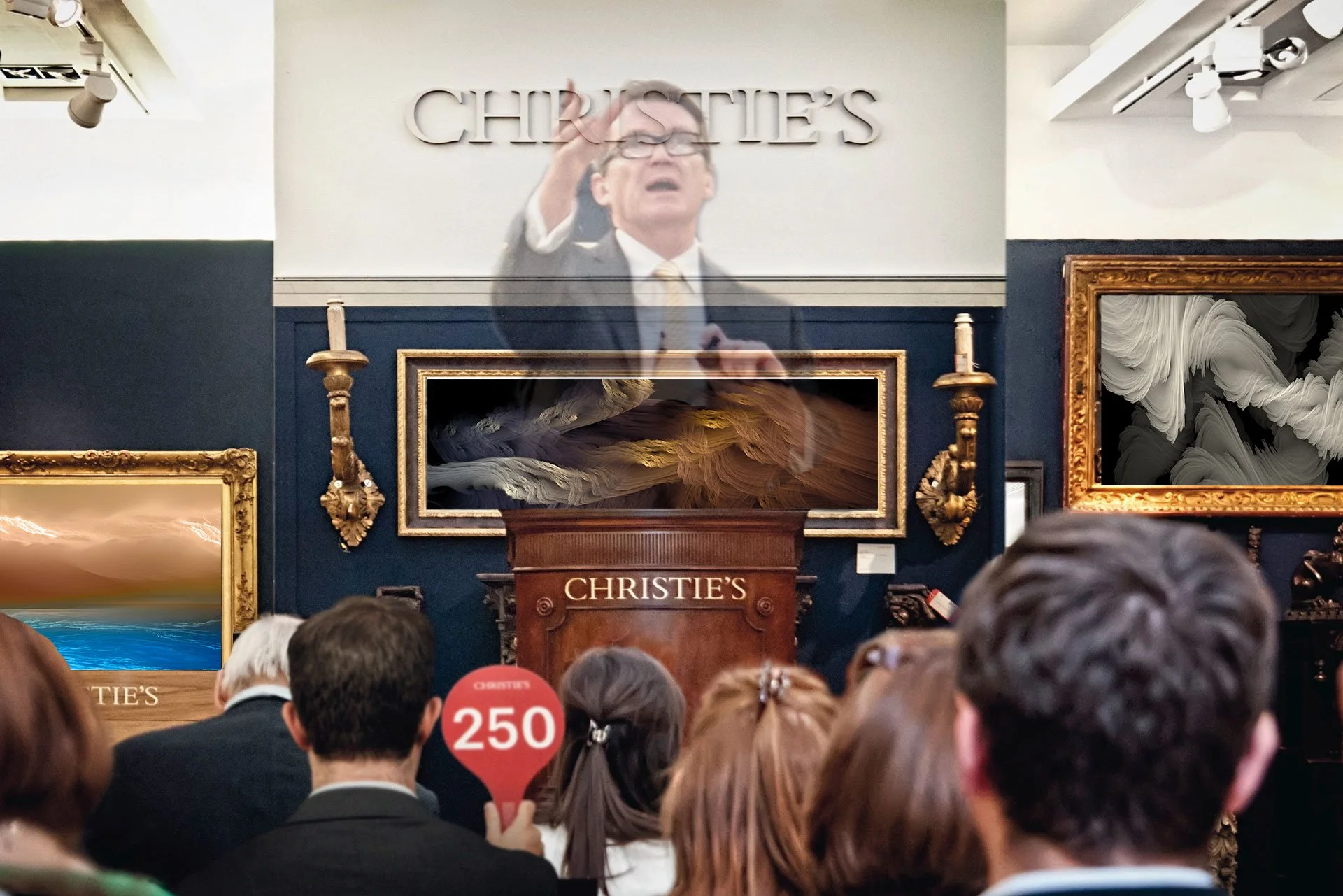
An auctioneer’s ghost at Christie’s taking a bid from the chandelier. Caveat: I replaced the actual Christie's paintings with my own!
Every November, the auction houses stage their annual Broadway production. Christie’s rolls out its numbers, the press reacts with automatic enthusiasm, and the headlines gush about a “market rebound,” as though one evening of bidding could resurrect an entire ecosystem. This year’s script delivered the usual spectacle: $690 million in sales, $2.2 billion across the week, and a chorus of commentators insisting the art market is suddenly “healthy” again. It’s the same choreography every year, and everyone knows their role.
But none of this tells us anything meaningful about artists, galleries, or the cultural economy. It isn’t a metric; it’s a ritual — a performance meticulously engineered to maintain the aura of confidence and inevitability. And yet the punditry continues to misread the motives behind these headline-grabbing numbers. A perfect example is the $236.4 million Klimt. The press treated it as a grand gesture of cultural signaling, as if billionaires throw around a quarter-billion dollars to impress each other with taste. That interpretation misunderstands how real power behaves.
The ultra-wealthy save for “tech bros” and do not showboat. They don’t need to. They already own the infrastructure: the companies and access to media outlets to promote their wares. The people who perform status spending as if they were actors playing a part are the ones trying to climb into that world — the nouveau riche, the hedge-fund strivers, the crypto kids. They make noise because they are insecure. The mighty move quietly, through advisors, consortia, intermediaries, and shell corporations. They don’t raise paddles; they move markets.
If the rumors surrounding the Klimt are true — and they almost always are — the buyer is one of the usual suspects. Possibly a Saudi prince. Perhaps a sovereign wealth vehicle. Possibly a consortium shielding a larger political or cultural agenda. But let’s be clear: if a Saudi royal acquired the painting, it wasn’t to spark envy on Instagram. Their acquisitions are geopolitical, not social. They consolidate cultural sovereignty. They reallocate wealth outside Western banking systems. They plant seeds for future national museums. They strengthen diplomatic leverage, and this has nothing to do with bragging rights. It is statecraft dressed in silk.
Meanwhile, auction houses are hardly neutral brokers. Their business model depends on rumor, opacity, and myth-making. They thrive on choreographed suspense and whispered identities. They help launder wealth, legitimacy, and narrative in equal measure. A $236 million sale can easily be the product of a consortium — strategic, coordinated, anonymous — and the public NEVER knows. What matters is that the performance convinces the audience that the system works, that the market is strong, that the illusion is alive.
And none of this money circulates back to the people who create the work. These astronomical figures reveal nothing about rising studio rents, medical bills, debt, the instability of artistic income, or the absence of resale royalties in the United States. They do not capture how isolating it feels for an artist to watch their work become proof of a “healthy market” while the creator struggles to find the time or resources to make the next piece.
If you want to understand the fundamental economics of art, step away from the auction block and walk into any major art fair. An average painting might sell there for around $5,000. After the gallery takes its 50% percent commission, and the IRS claims its share. The artist is left with maybe $2,000 — enough to cover a month’s rent in Los Angeles if you’re lucky, or a mortgage payment in Helena, Montana. The irony is that galleries have become “the new starving artists,” operating on razor-thin margins and desperate sales. Art consultants, advisors, and even the artists themselves may end up replacing them entirely. The ecosystem is quietly cannibalizing itself while the auction houses make noise about “recovery.”
As we approach Miami Art Week, this machine will shift into full volume. Art Basel Miami Beach has become the industry’s annual sermon of optimism — the cathedral where everyone gathers to perform the fiction that everything is fine. The auction is the prologue. Basel is the crescendo. Collectors show enthusiasm for each other. Galleries take on existential financial risk to stand in the right rooms. Institutions wander the aisles to signal they still matter. Everyone pretends the system is stable because acknowledging the truth would collapse the ceremony.
The real story is not the Klimt. It’s the fiction we keep buying. A billionaire does not spend $236 million for status. That’s what the almost-rich think they do. The truly powerful shape culture, consolidate influence, and move wealth across borders in ways most people will never see. Look at J. Paul Getty, who left behind two public museums that now educate millions. Look at John D. Rockefeller, whose cultural, scientific, and social philanthropy permanently altered the American landscape. These are not gestures of vanity — they are acts of cultural engineering.
The auction room is a theater for the nouveau riche. The real motives live in the dark. And until we are willing to talk about that honestly, we’ll keep applauding the performance without ever questioning the plot.