
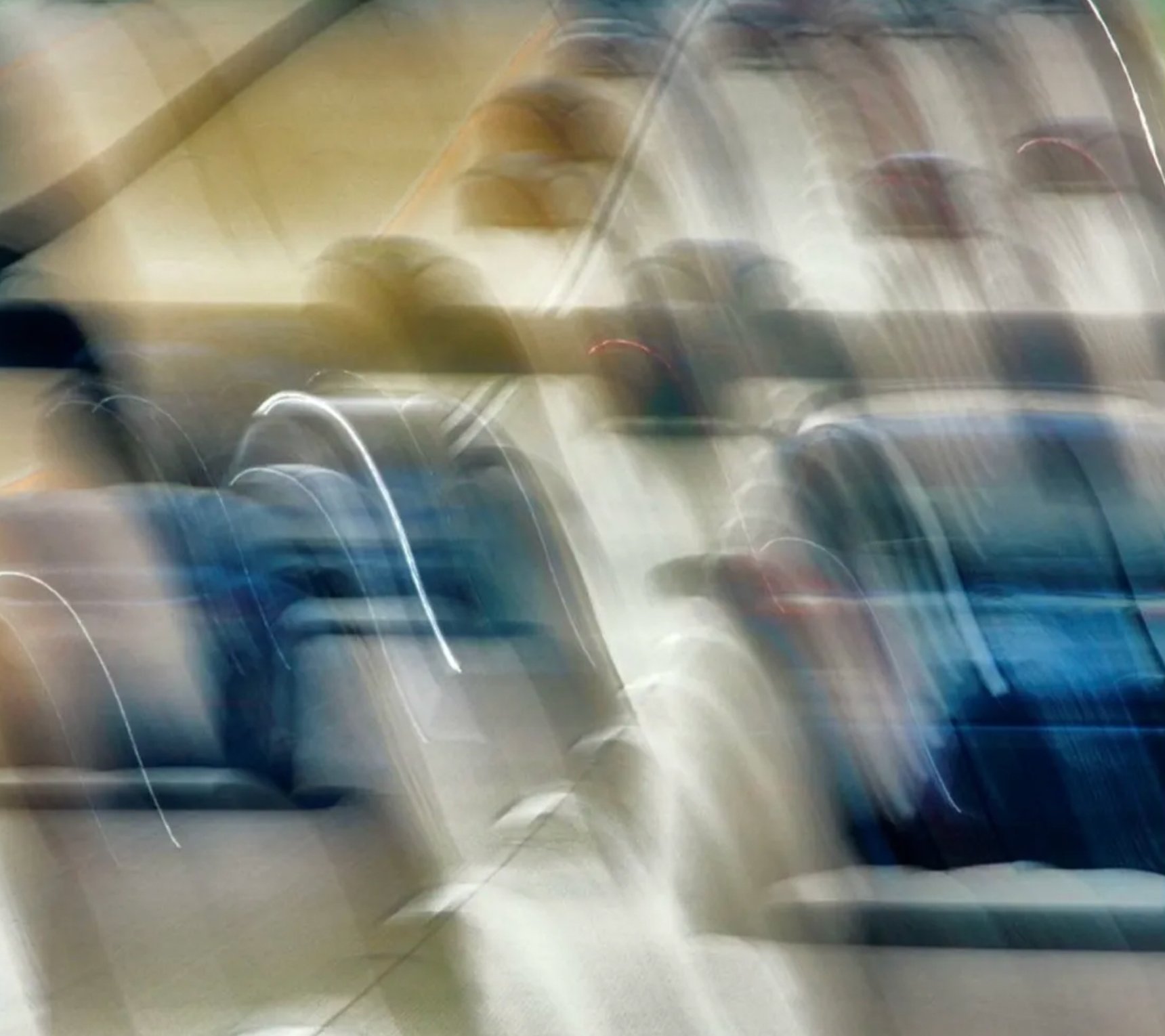
There is a strip of America that doesn't quite know what it is. Not desert, not city. Not wild, not tamed. It runs along the northwestern rim of the Los Angeles Basin, where the Inland Empire bleeds into the Mojave — a landscape of transmission towers, Joshua trees, ochre grass baking under a pale sky, and mountains that hover in the distance like suggestions. Most people drive through it at 80 miles an hour without looking. Edward Lance Montgomery has spent years looking at almost nothing else.
And what he sees, he refuses to resolve.
His photographs are blurred. Emphatically, intentionally, structurally blurred — not through accident or post-processing, but through the oldest trick available to a camera: the long exposure, the moving hand, the shutter held open while the world keeps turning. The technical term is ICM — Intentional Camera Movement. The more accurate term is impressionism. The most accurate term is painting.
When the French Impressionists scandalized the Salon in the 1860s, the argument against them was essentially this: you can't see it that way. A cathedral does not smear across the morning light. Water does not dissolve into pure color at the edges. Trees do not become suggestions of themselves at dusk. The critics were right, of course, in the narrowest sense. The eye, locked on a fixed point, resolves what it sees. But the eye is almost never locked on a fixed point. Consciousness moves. Attention drifts. The world as we experience it — as opposed to the world as a camera with a fast shutter and a fixed tripod records it — is precisely as unstable as Monet suggested.
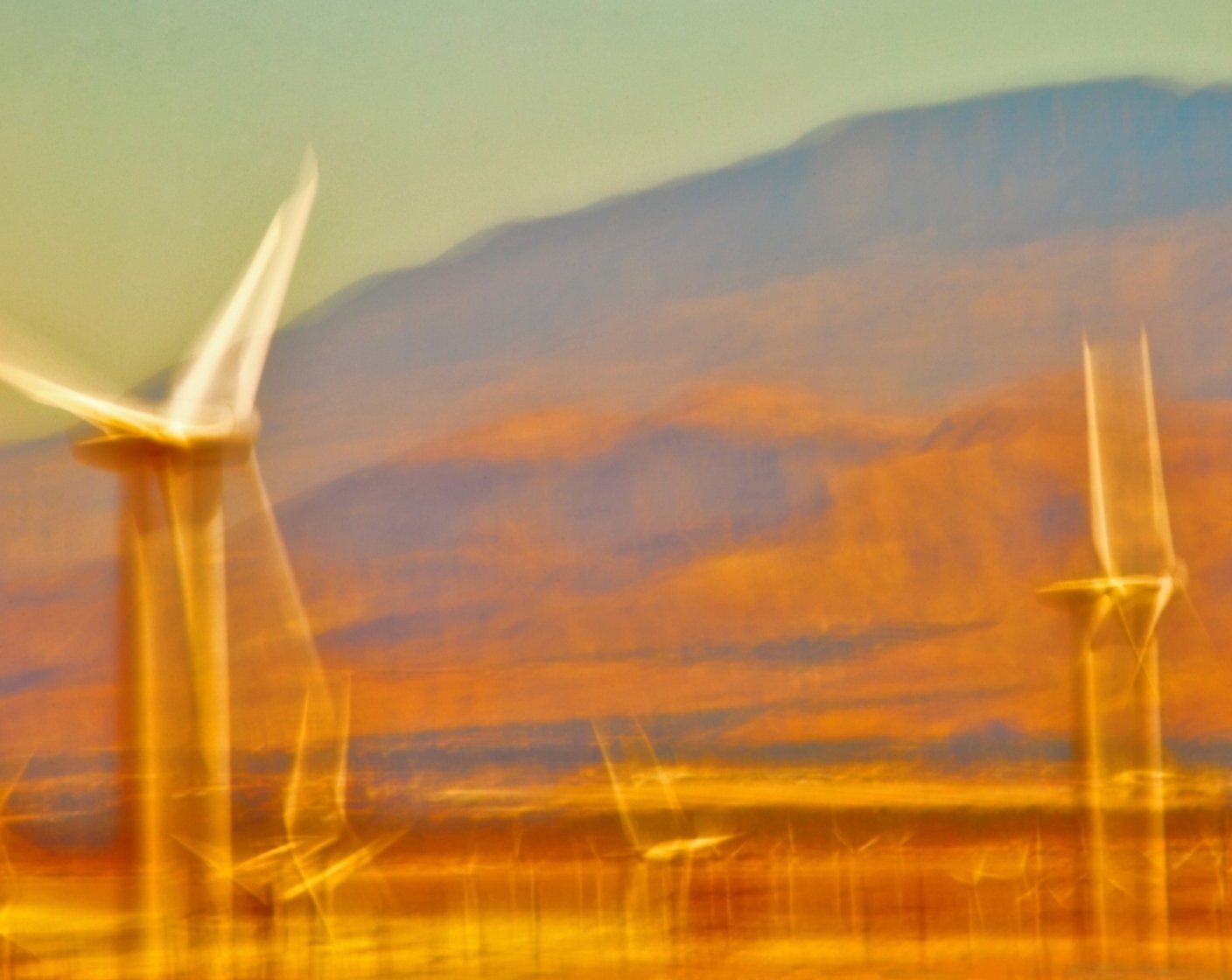
Montgomery understands this in his bones. His photographs do not document the Mojave. They record what it feels like to be present inside it — the heat shimmer that softens every edge, the peripheral blur of a landscape glimpsed while moving through it, the way a Joshua tree at the center of an empty field seems to shimmer and multiply as if the desert itself is refusing to let you pin it down. In one image, a single palm fractures into a dozen overlapping versions of itself, its fronds fanning out like a starburst, surrounded by the ghosted lattice of power towers receding into a turquoise haze. The ground is pure burnt sienna. The sky is the color of old glass. It looks like nothing a camera should be able to produce — and everything a painting by someone who had actually stood there, disoriented and overwhelmed, might try to capture.
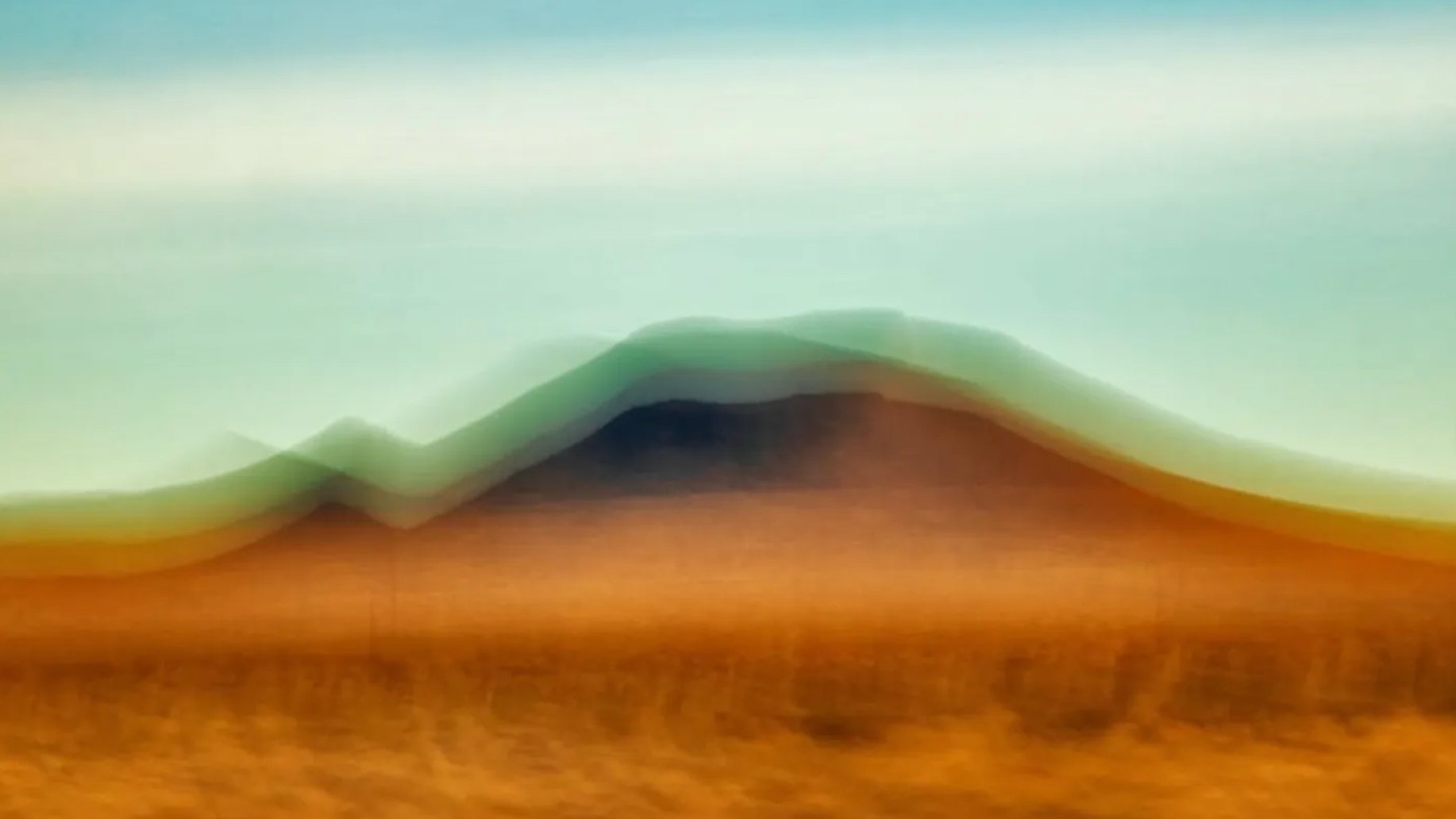
The subject matter is not incidental. The Mojave edge is a particular kind of American emptiness — one defined almost entirely by contrast. The transmission lines running through Montgomery's frames are not industrial intrusions. They are the connective tissue between the sprawl behind them and the void ahead, and in his long exposures they become something else entirely: calligraphy, webs, the scored lines of a musical staff carrying nothing but light. Mountains that would be mundane in a sharp photograph become, under his treatment, layered color fields — bands of rust, violet, and sage stacked like geological time made visible in an afternoon.
There is loneliness in these images, but not desolation. That is a crucial distinction. The Mojave edge is not an absence; it is a pressure. The city pushes against it from one side, the desert resists from the other, and in the space between them something unresolved and alive persists. Montgomery's blurs do not erase that tension — they embody it. The chaos in the camera's motion is the chaos of the place itself: the Santa Ana winds that send golden grass sideways, the heat that bends light into something visible, the freeway traffic that turns the horizon into smeared color at the edges of consciousness.
Montgomery was recently exhibited at a public venue where his large-format prints drew audiences who had never thought about photography as a medium capable of this. Standing in front of his desert mountain — that extraordinary image of a cinder cone wrapped in translucent green and brown halos, floating above a field of amber grass — people kept reaching for the language of painting. It looks like a watercolor. It looks like a Rothko. It looks like something you'd see in a museum. They weren't wrong. They were just surprised that the tool was a camera and the medium was light and time rather than pigment and canvas.
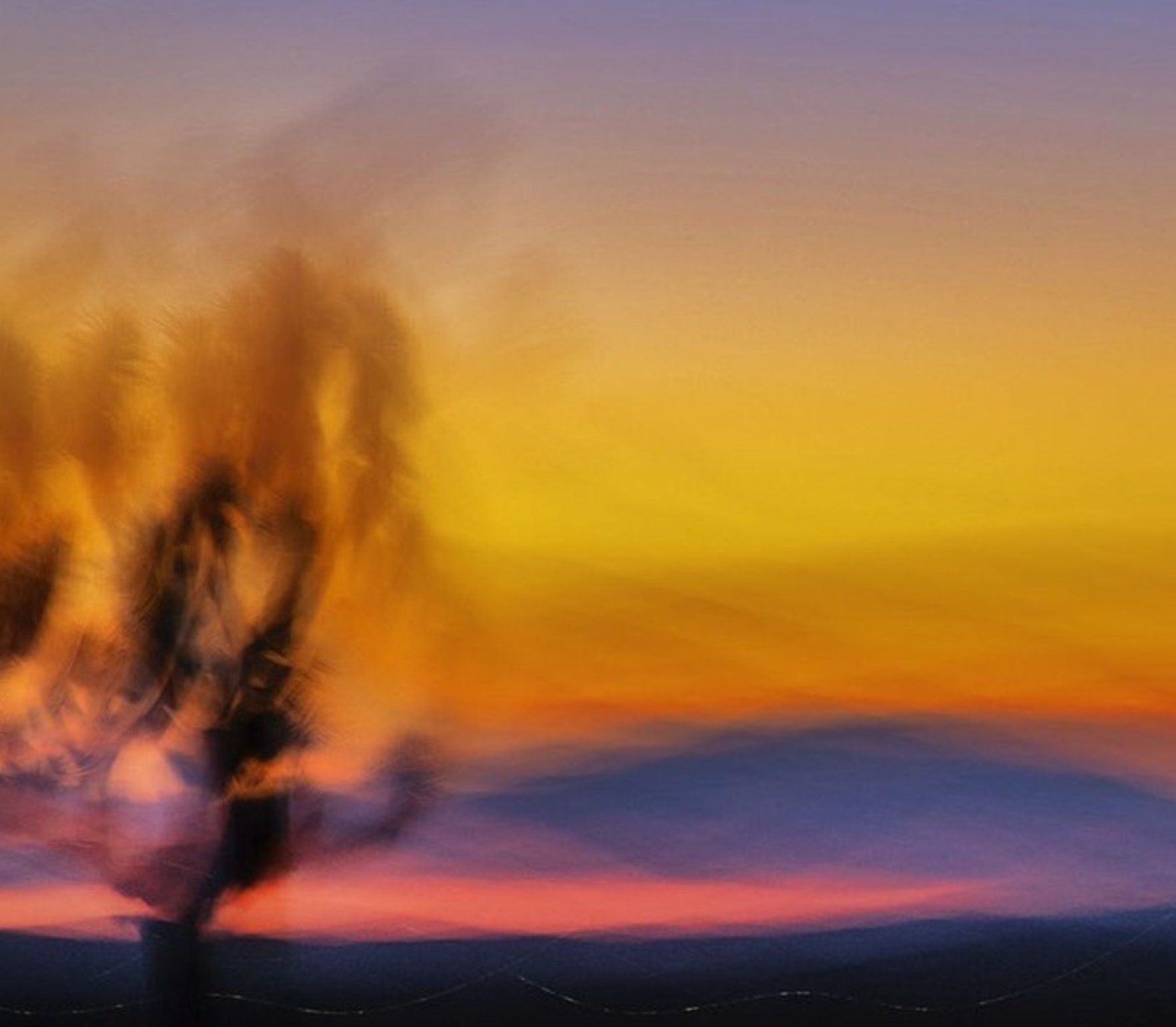
That surprise is worth examining. Photography has spent most of its history fighting to be taken seriously as an art form by demonstrating what it can do that painting cannot: the frozen instant, the forensic detail, the irrefutable record of what was there. Montgomery has essentially decided that fight is over and moved on. He is not trying to prove anything about photography. He is trying to show you the desert the way the desert actually lands on a human nervous system — partial, luminous, overwhelming in its scale, and resistant to the kind of clean resolution we pretend the world offers us.
This is what impressionism always was. Not a technique. A philosophy of perception.
The Mojave has been waiting a long time for someone to paint it the way it deserves. It turns out the painter had a camera.
Edward Lance Montgomery