
Everyone Is a Curator Now — And That’s the Real Problem
FRIEZE MAGAZINE: Who Killed the Independent Curator? Biennials have become a side-hustle for institutional directors, creating far-reaching consequences for the global art world: Link
The recent hand-wringing over the “death of the independent curator” feels oddly familiar. It echoes the advertising world of the 1980s, when desktop publishing and early digital tools sparked a panic summarized by a famous line: “Everyone is an art director now.”
That slogan wasn’t wrong—but it also wasn’t the real threat.
The real threat was not democratization. It was power concentrating upward while accountability thinned out.
Today’s art world is replaying that pattern almost verbatim. The anxiety isn’t really about independent curators disappearing. It’s about who gets to decide, who pays, and whose taste is protected from scrutiny.
The Cost Problem Nobody Wants to Name
Independent curators are expensive. Not just financially, but structurally.
They require:
Fees that don’t neatly fold into institutional payrolls
Autonomy that resists donor preferences
Time, travel, research, and risk
Freedom from internal hierarchies
Institutions increasingly don’t want that friction. It’s cheaper, safer, and more controllable to fold curatorial authority inward—toward salaried staff, directors, or consultants already embedded in existing power networks.
When critics describe this as the “brushing aside” of curators, that part is accurate. But the cause isn’t cultural decay—it’s institutional convenience.
Nepotism, Soft Power, and the Curatorial Echo Chamber
There’s an uncomfortable truth often left unsaid: curatorial culture can look nepotistic from the outside because, in practice, it often is.
Not always maliciously. More often through:
Repeated use of the same artists
Reliance on familiar networks
Social and educational homogeneity
Career circulation within elite circles
That’s how closed systems behave, even when intentions are good.
So when the phrase “everyone is a curator now” gets tossed around as an insult, it misses the point. The problem isn’t that too many people think curatorial thoughts. The problem is that too few decisions are exposed to open competition.
The Board of Directors Is the Real Curator
Here’s the part that makes everyone uncomfortable:
Ethics and politics in museums do not start with curators. They start with boards of directors and major donors.
Board of Directors:
Want their collections exhibited
Want reputational safety
Want alignment with their values and investments
Want predictability
That reality quietly shapes exhibitions long before any curatorial statement is written.
Blaming curators—or mourning their loss—without addressing governance is like arguing about set design while ignoring who owns the theater.
A Proposal That Would Change Everything
If institutions genuinely care about artistic merit, diversity of vision, and credibility, there’s a brutally simple experiment that would expose the truth:
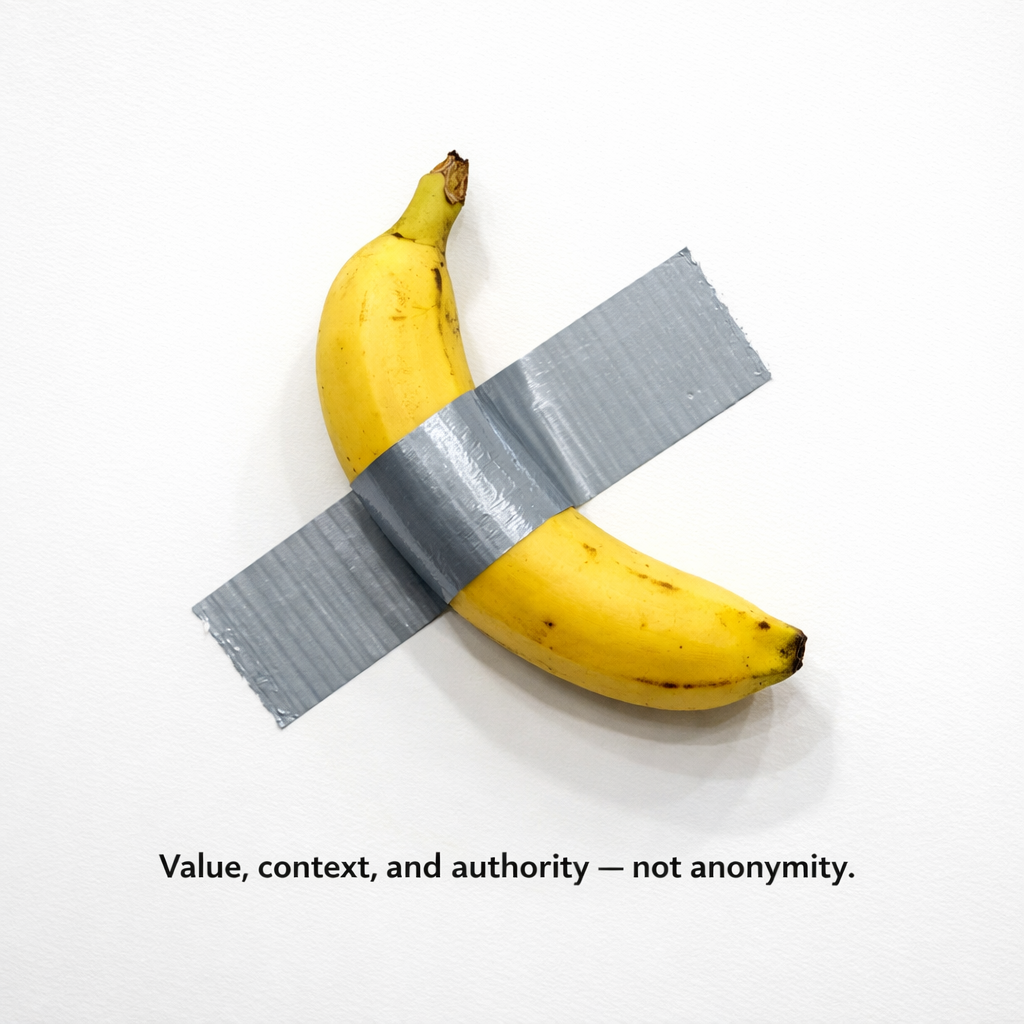
Open-call curatorial bake-offs with anonymous submissions.
No names.
No résumés.
No gallery affiliations.
No social capital.
Just the work.
Curators would still curate—but from a pool where taste must stand on its own, not on proximity to power.
Yes, it would be messy.
Yes, it would offend some people.
Yes, it would break habits.
That’s the point.
Why This Threatens the “Cool Kids” Narrative
The mythology of the art world depends on scarcity of access, not scarcity of talent. Anonymous selection punctures that myth immediately.
If the best work rises without pedigree, then:
Gatekeeping loses its justification
Networks lose their camouflage
Boards lose plausible deniability
Curators regain legitimacy through judgment, not affiliation
That outcome should terrify anyone invested in exclusivity masquerading as rigor.
Not Anti-Curator. Not Anti-Institution. Pro-Art.
This isn’t an argument for abolishing curators or flattening institutions. It’s an argument for restoring credibility through competition and transparency.
Curators matter. Institutions matter. But neither should be protected from scrutiny by tradition alone.
If the art is strong, it will survive anonymity.
If the curatorial vision is strong, it will survive open process.
If the institution is ethical, it will survive losing control.
And if any of those can’t survive that test—then the problem was never democratization.
It was fragility.