
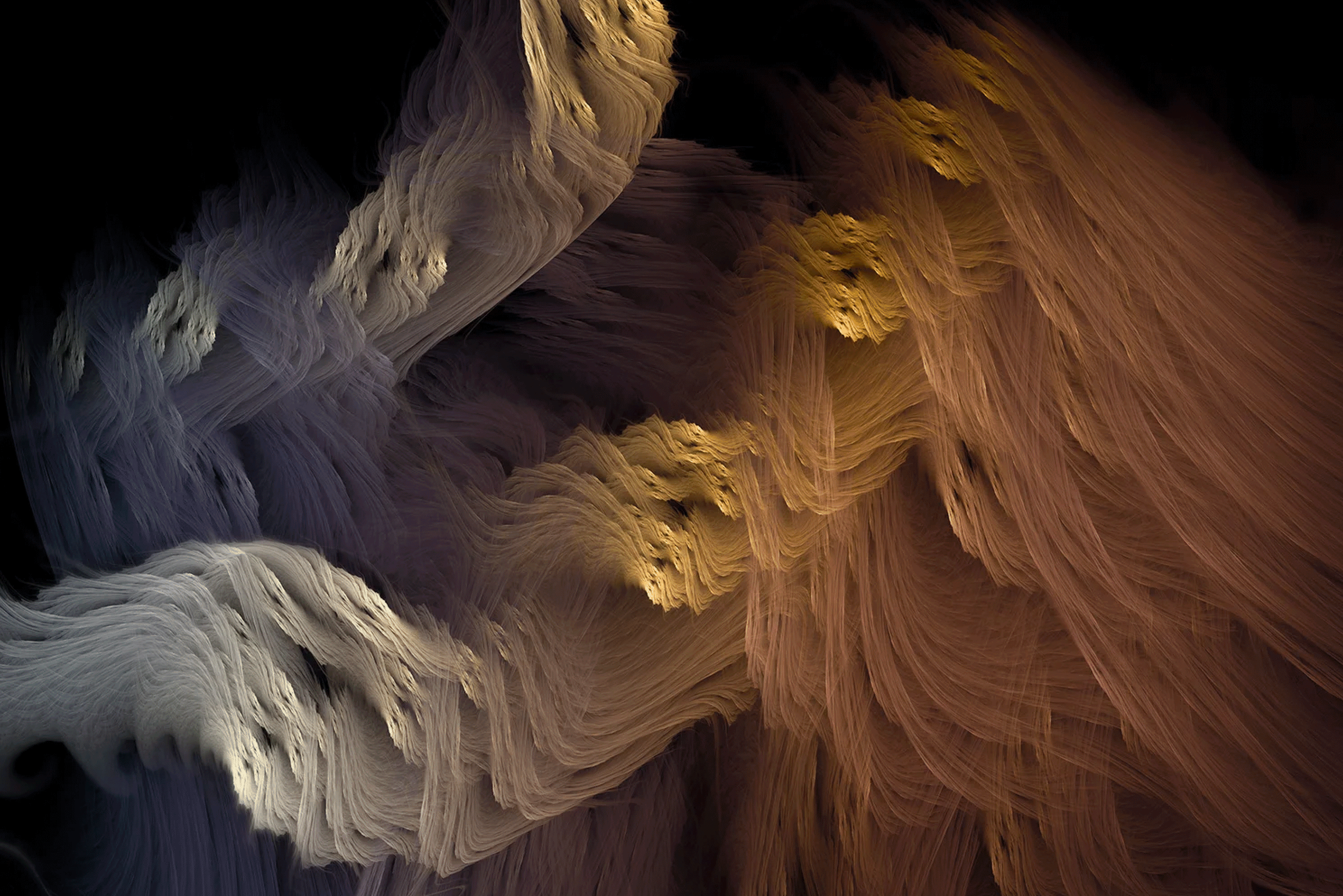
A fractal Flame collage from my Ectropy series. 40”x 60” inches. Edition of 8
Ectropy is the opposite pressure of entropy — the rising force of complexity, structure, memory, and life. Where entropy unravels pattern into noise, ectropy gathers it. It is the improbable tendency of the universe to build stars, cells, minds, civilizations — anything that grows instead of collapsing. In this sense, a painting is not merely an artwork. It is an ectropic act.
To paint is to resist dissipation. Pigment is chaos until guided; canvas is void until shaped. Every stroke interrupts disorder, turning raw material into meaning. A horizontal work intensifies this feeling — read like landscape, strata, horizon-line — a geometry of geological time. Such a format implies aeons, sediment, and a universe thinking in layers rather than moments.
In this piece the concept deepens into the Jacob’s Demon idea: imagine entropy has already consumed nearly all that could be destroyed. Stars dimmed, heat spent, chaos fully expressed. And then — in the stillness after collapse — a new order begins. Not born from violence, but from the exhaustion of it. When there is nothing left to break, ectropy becomes inevitable. Gentle. Patient. Sublime.
Fibrous currents gather like the first architecture of matter. Light folds inward as if remembering how to ignite. It is not the beginning of the universe, but the second beginning — the moment when creation returns after ruin. A quiet genesis.
To collect such a work is to hold a fragment of that renewal — a vision of order rediscovering itself. The painting asks one question, softly but permanently: What forms rise when the universe is finally quiet enough to grow again?
What startles me most, and what convinces me we are knowledge-throttled creatures, is the nature of infinity itself. Not as something large, but as something for which the mind has no place to stand. Infinity has no first cause, no origin point, no final hour. It isn’t just beyond measurement — it exists outside the very grammar of thought. We can say the word, but we cannot hold the concept. Try to imagine a beginning with no beginning, or a boundary that never arrives, and the mind buckles like a bridge with one beam missing. It makes me wonder if some ideas lie permanently outside human comprehension — not because they are hidden, but because our brains were not built to contain them. And in that realization, I feel two things at once: awe, and a small, claustrophobic shiver. As if infinity isn’t a horizon — but a window we can see through, yet never climb beyond.